Reimagining the
Creator Experience
A strategic systems case study · thortful
This is a retrospective case study of a content and creator strategy I led at thortful. The decisions and outcomes were real; this document applies a strategic framework to work that was largely instinct-led and internally documented at the time.
OVERVIEW
The Problem with Scale
When a platform grows fast, its systems don't always keep up. At thortful, rapid growth exposed a fundamental design flaw: a creator base of thousands was being treated as a single audience.
thortful is a two-sided marketplace connecting independent card designers with customers. Creators submit designs, moderation determines catalogue visibility, and royalties are generated per sale. The model depends entirely on a healthy, high-quality catalogue — which in turn depends on creators who understand what the platform needs from them.
During the pandemic, the platform scaled rapidly. As growth stabilised and sales began to dip, sustaining commercial performance became critical. I moved from the B2C marketing team to the creator side of the marketplace — owning end-to-end strategy, leading a small team, and working cross-functionally with Customer Experience, E-commerce and CRM. The challenges we faced were systemic rather than isolated, so collaboration was essential.
My remit was to empower creators with the clarity and guidance they need to succeed — but what I found was a system actively working against that goal.
01. THE CHALLENGE
A Self-Reinforcing Loop
The business had introduced structured design briefs to address declining catalogue quality — a logical response to the problem. But the briefs exposed something deeper: a self-reinforcing loop that made things worse.
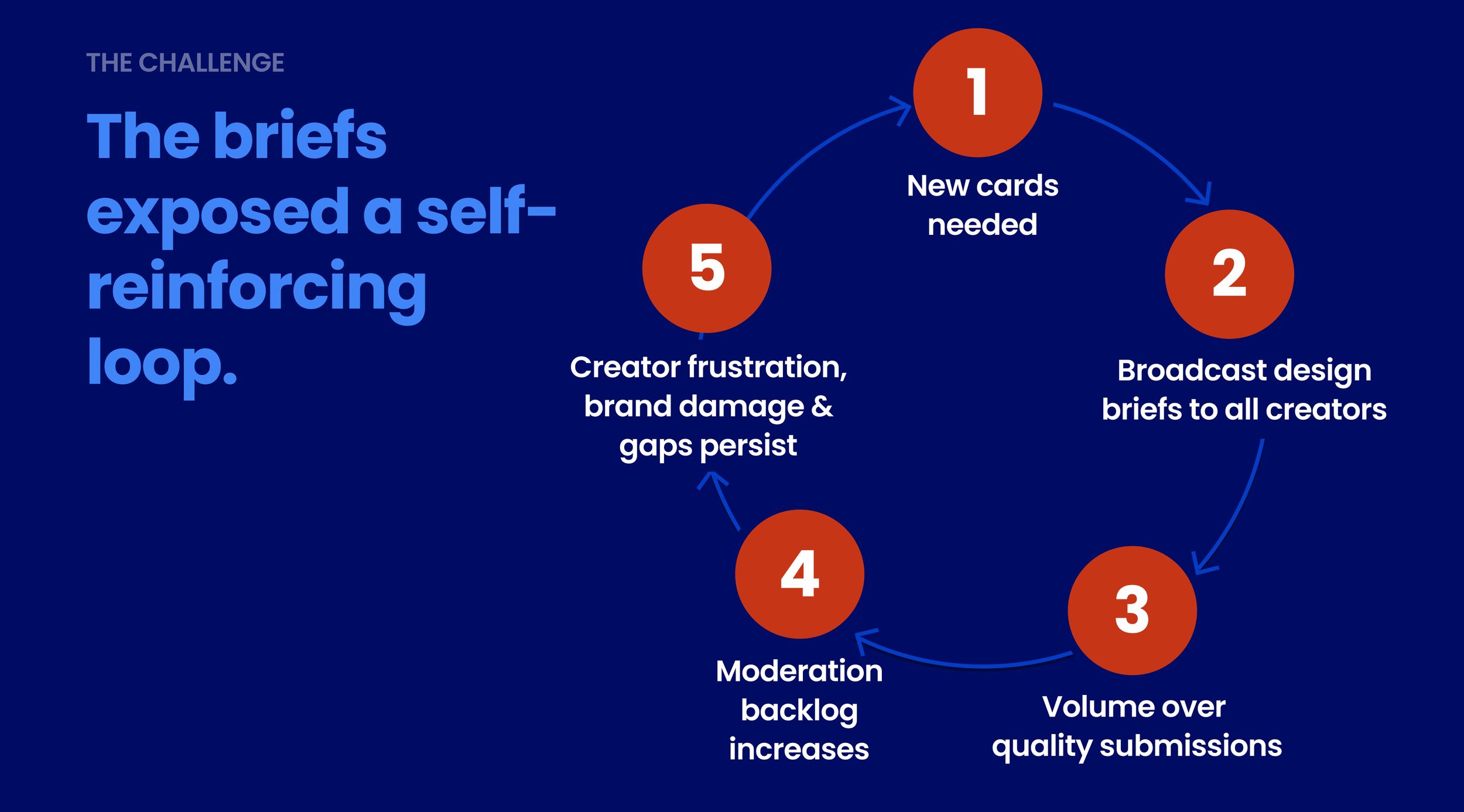
New cards were needed. Briefs went out to the entire creator base. Volume submissions flooded in. The moderation backlog grew. Rejection rates rose. Creators felt frustrated and disengaged. Catalogue gaps persisted. So new cards were needed again.
The briefs weren't solving the problem. They were amplifying it — because they treated every creator the same. We were unintentionally training creators to fail by sending them briefs they weren't equipped for.
The Moment That Crystallised It
A high-profile designer joined the platform with over 100,000 followers. We didn't even know she'd joined until she complained her designs were rejected. The designs were strong — but they hadn't been commercially adapted to greeting cards. The moderation team was technically correct. Strategically, we had failed her entirely.
Our onboarding hadn't equipped her with the knowledge of what sells on the platform or how to adapt her work to the format.
The creator experience wasn't built for varying levels of expertise, and this was costing the business top creative talent.
02. THE APPROACH
Designing for Creator Context
The solution required two things working in parallel: a segmentation framework that reflected how creators actually differ, and a targeting logic that could activate the right content for the right person at the right moment.
The Creator Lifecycle Framework
I developed a four-tier lifecycle model based on capability and intent — moving creators from Prospect through Exploration, Development, and Performance into Partnership. Each tier carried different expectations, different support needs, and different commercial value to the platform.
But lifecycle stage alone wasn't enough. Two creators at the same tier could have completely different motivations — and motivation shapes behaviour more than capability does.
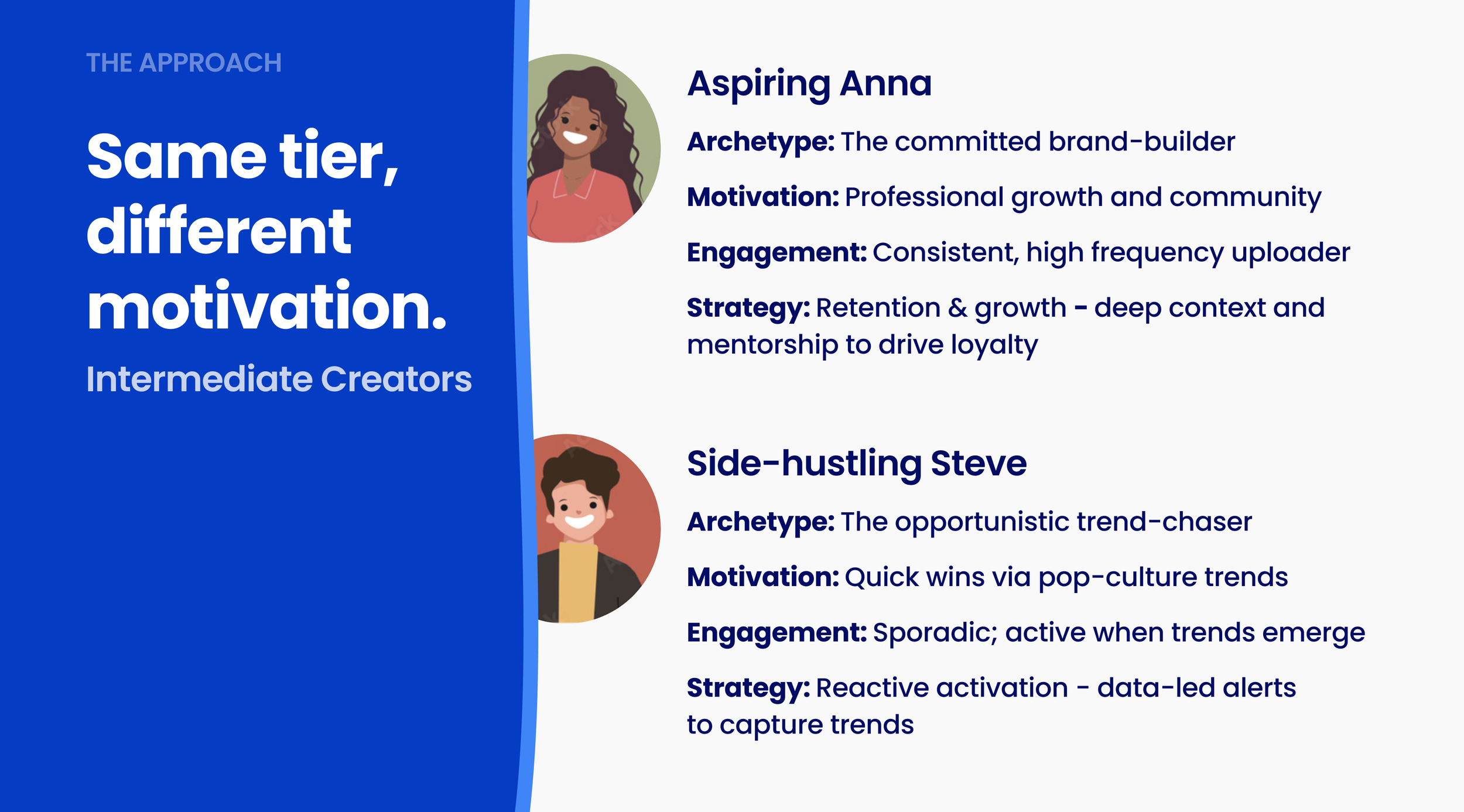
Key insight: Same tier, different motivation.
Aspiring Anna: a committed brand-builder. She uploads consistently, seeks mentorship, and responds to deep context and commercial guidance. Success measured through loyalty and consistent growth.
Side-hustling Steve: an opportunistic trend-chaser. He's sporadic, activates around cultural moments, and needs reactive, data-led prompts. Success measured through reactivity and trend capture.
This distinction matters beyond just brief targeting. In a broadcast model, Steve looks disengaged. In a segmented model, we understand he's dormant — waiting for the right trigger. That difference protects metric accuracy and prevents wasting retention effort on someone who doesn't need retaining.
Two-layer targeting logic
Layer 1 — Answers: are they capable?
Eligibility
Filter by lifecycle tier, determined by behavioural and performance data. A brief only reaches creators at the right capability level.
Layer 2 — Answers: are they suitable?
Relevance
Match brief to creative style, determined by dominant moderation style tags. A brief only reaches creators whose catalogue already aligns.
The logic here came directly from my CRM background. In CRM, we saw that matching content to prior user behaviour significantly increased engagement — sending a rude Christmas cards launch email to someone who'd bought rude cards before was measurably more effective than a generic broadcast. I applied the same principle to creator targeting: sending a 'cheeky card' brief to creators already strong in humour becomes a personalised invitation rather than a generic call-to-arms.
The goal wasn't exclusion — it was precision. Avoiding over-activation of the wrong audience reduces unnecessary rejection cycles and protects the creator relationship.
It's illogical to request modern humour from traditional illustrators. Relevance isn't a nice-to-have — it's the difference between a brief that builds confidence and one that erodes it.
03. ACTIVATION
What we actually shipped
Strategy is only as good as what it enables. And here the strategy ran into a real constraint: implementing the full segmentation model required cross-functional support across product, CRM, and data that, at the time, wasn't resourced. The business was focused on customer acquisition — lifecycle personalisation wasn't the priority.
So I adapted. The goal shifted from perfect segmentation to making the broadcast smarter — and from there, building the infrastructure that could support proper segmentation later.
Prioritised Personas
Rather than trying to serve all personas simultaneously, I focused activation on two core and two secondary personas — making commercial priorities explicit in every brief rather than leaving creators to guess what the platform needed.
Creator Central
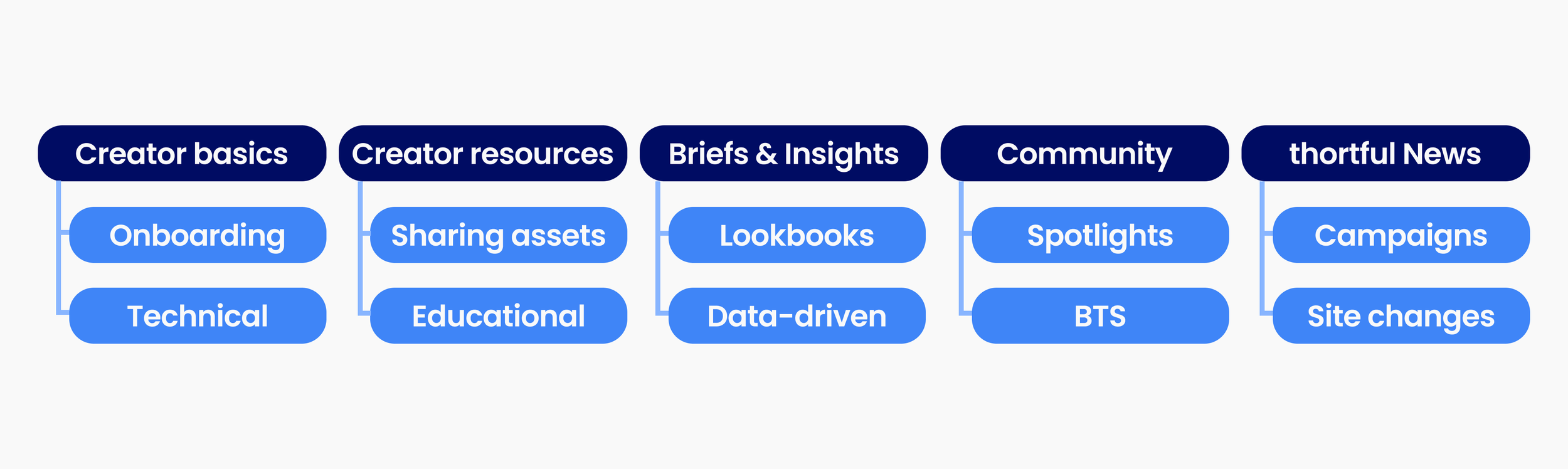
When tailored support wasn't scalable, we built Creator Central: a structured self-serve hub where creators could find onboarding guidance, technical resources, design briefs, and insights without relying on the team for answers. I partnered with customer service to build content around recurring friction points, simplified internal jargon, and ensured consistent terminology across the experience. The information architecture moved from reactive support to proactive clarity.
Seasonal Lookbooks
We introduced seasonal Lookbooks as an inspiration tool — giving creators commercial context and aesthetic direction ahead of key occasions. The goal was to shift creator behaviour from reactive to anticipatory, which had a secondary benefit: earlier submissions reduced moderation bottlenecks and gave the marketing team earlier access to fresh content ahead of major campaigns.
Newsletter Refocus
Creator newsletters were refocused away from community news and toward commercial guidance — explicit data on what was selling, what was needed, and what moderation was looking for. We were communicating with people running small businesses under real pressure. They needed actionable intelligence, not updates.
04. MEASUREMENT
Correcting the metric
Before measuring the impact of the new system, I had to fix a distortion in how we were measuring creator performance. When I joined the team, performance was largely measured by total sales per creator — which sounds logical until you look more closely.
A single viral card featured in an ad could inflate a creator's perceived performance. We were measuring visibility, not reliability. Celebrating spikes, not consistency.
I proposed shifting the primary metric to catalogue acceptance rate — the percentage of submitted designs approved for discovery — combined with average sales per approved design. This separated quality from luck, and surfaced a problem the old framework had been hiding: we had many 'one-hit-wonders' whose majority of designs weren't approved, yet who appeared in our list of top creators.
What we measured and why
Email engagement (OR/CTR) - was guidance becoming more relevant to the people receiving it?
Lookbook views — were creators actively seeking commercial guidance, or ignoring it?
Proportion of 4–5 star moderated designs — was design quality improving across the catalogue?
Upload timing relative to key occasions — were creators responding earlier, suggesting better commercial awareness?
Behavioural change was the leading indicator. Sustainable commercial impact requires longer-term measurement.
05. IMPACT
Behaviour Changed Before Revenue Moved
Early indicators validated the directional shift:
These were early signals that things were improving — even before revenue could fully reflect the change. Any revenue impact would have required longer-term measurement than I was involved for.
06. REFLECTIONS
What This Work Taught Me
Three things I'd carry into every product project from here:
Align strategic ambition with operational capacity early. I came into this role with a lot of ambition — and genuinely believed the business was ready to invest in a structural shift. I've since learned how important it is to sense-check operational capacity before designing the solution, so strategy and constraints are aligned from the start.
Design metrics that reinforce the behaviour you want to scale. Total sales was the headline metric — which meant we were celebrating spikes rather than consistency. Metrics don't just describe what's happening; they influence where attention goes. I'm now much more deliberate about asking: what behaviour are we actually rewarding?
Pair intuitive insight with structured research. Much of the persona work came from lived experience working across the business. But I've learned that structured research carries weight in a different way — especially with senior stakeholders. If I were doing this again, I'd formalise those insights earlier. Not because the intuition was wrong, but because evidence helps align everybody.