Village Resale App

THE CONCEPT
It Takes a Village
While working at thortful, I noticed something about customer loyalty: people stayed with competitors like Moonpig not because the product was better, but because they'd invested effort upfront — saved dates, occasion reminders. That effort became an anchor.
Most resale platforms optimise in the opposite direction: frictionless, fast, forgettable. Village tests whether the thortful principle transfers. If parents invest a small amount of effort building a personalised feed — the brands, sizes, and styles that fit their family — will they feel more invested in the platform, and come back more often?
The name comes from the phrase that surfaces constantly in parenting communities: "it takes a village to raise a child." In Village, parents literally build their own — following other parents whose kids' sizes, brands, and style match their family's, so their feed is shaped by people rather than algorithms. Instead of searching a vast anonymous marketplace, discovery is filtered socially before it begins.
Frictionless conversion is the industry default. But frictionless experiences are also forgettable. The effort creates the investment.
01 · RESEARCH & PROBLEM DEFINITION
The Problem Isn’t Supply
Plenty of platforms already let parents buy and sell second-hand children's clothing, so supply was never the issue. I looked at the problem from both sides of the marketplace: the parent using it, and the business running it. Two different problems emerged, feeding each other.
Scale without suitability
Existing resale apps are built for volume. Listings get lost in vast, anonymous feeds, and finding the right item for your child means sifting through everyone else’s. Inefficient and impersonal.
Transactions without retention
Frictionless marketplaces are easy to use — and easy to leave. Optimising purely for conversion gives parents no reason to return to this platform over any other. Forgettable is a business problem.
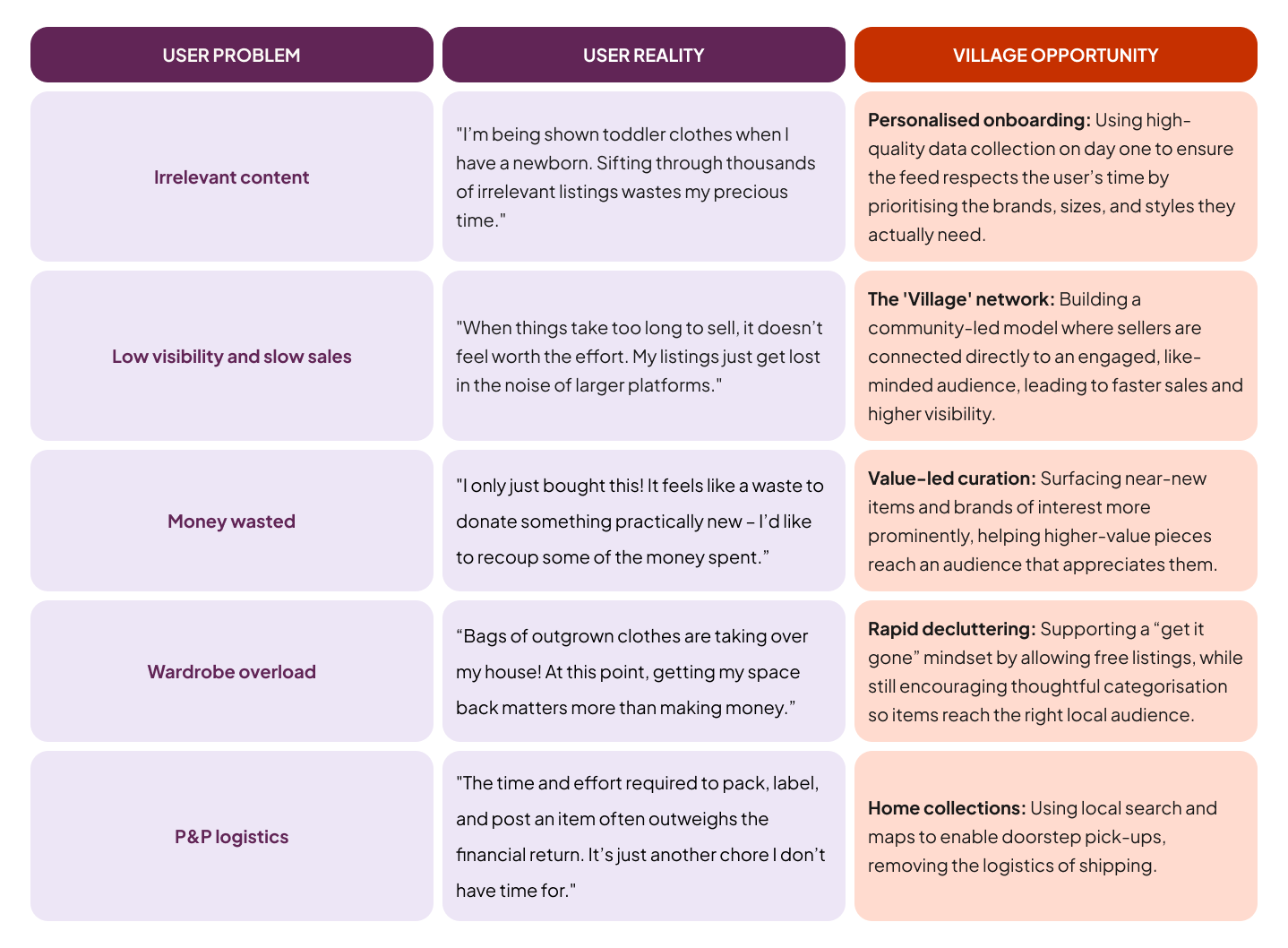
Both sides of this problem needed evidence, so I researched both: qualitative interviews with parents, alongside secondary analysis of parenting communities on Mumsnet and TikTok. The research distilled into five pain points that became the requirements for Village.
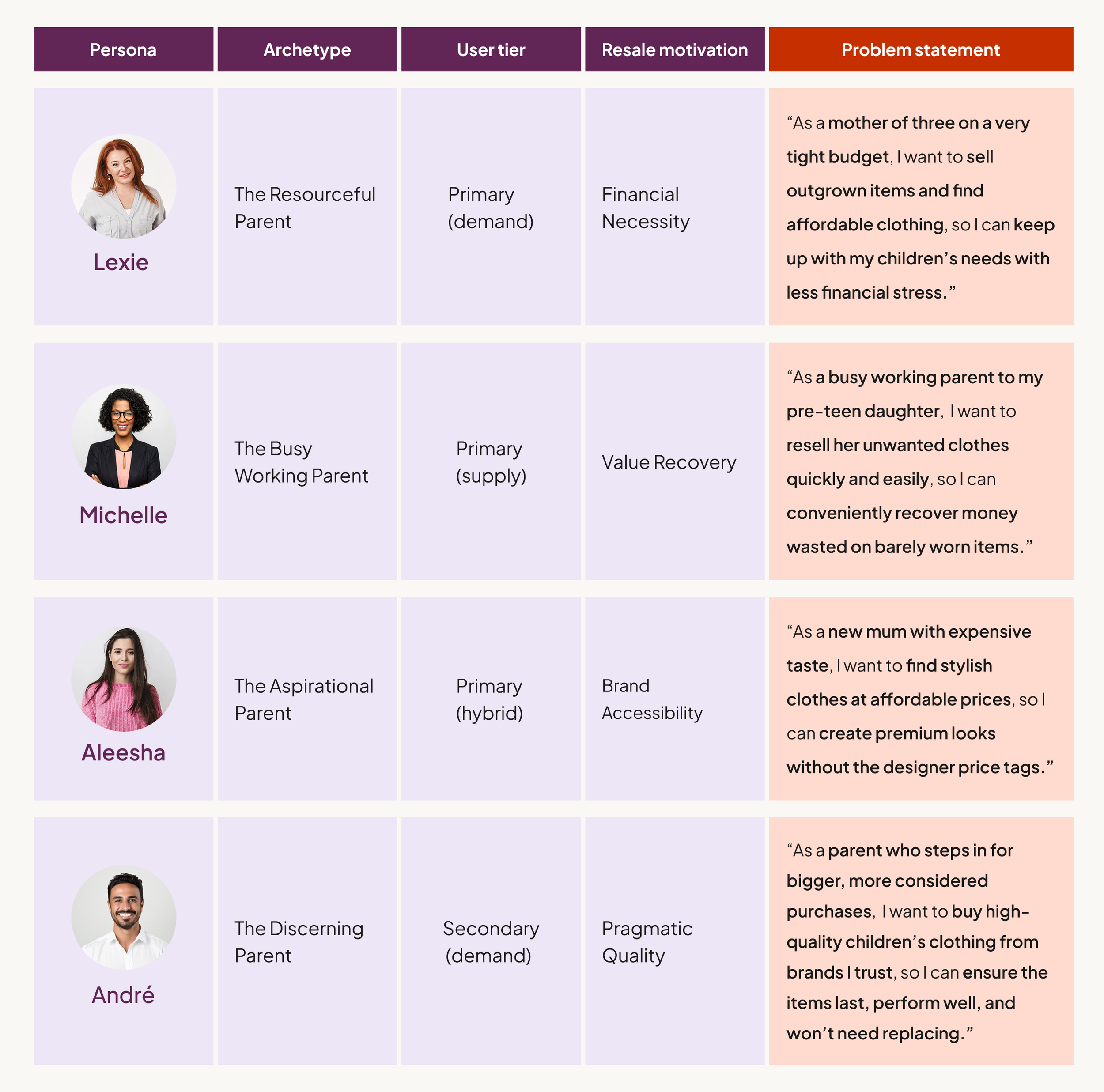
The parents I spoke to fell into four motivational archetypes — financial necessity (Lexie), aspirational brand access (Aleesha), value recovery (Michelle), and pragmatic quality (André). These weren't demographic segments; they were different reasons for being in a resale marketplace at all, and they shaped different needs from a feed.
Journey mapping and a scan of Vinted, eBay, YoungPlanet, and KidChing confirmed the pattern from both angles: high effort with uncertain payoff for parents, and platforms differentiated by little more than interchangeable sustainability-green branding. The research pointed towards a solution: relevance established before discovery, not after it.
02 · PRODUCT DIRECTION
From Better Search to Pre-Curation
The journey maps initially pointed toward familiar IA improvements (better filters, clearer categories, more accurate search results.) But I identified a deeper issue: even with perfect filters, parents would still be entering a noisy, anonymous marketplace. The problem wasn’t purely technical, it was social.
The problem wasn’t just how parents searched, but who they were searching among.
This shift defined the product strategy. Instead of improving search within the marketplace, Village filters discovery before it begins: a feed shaped by who a parent chooses to follow, layered over their size, brand, and style preferences. Each archetype builds a different village from the same mechanic:
Lexie follows parents with similar budgets, keeping her feed affordable
André follows parents with similar quality standards, ensuring trusted condition
Aleesha follows parents with a matching aesthetic, creating a curated edit, not a jumble
The result: discovery becomes personal before a single search is made. And because that relevance is built through the parent's own effort, it doubles as the retention anchor the hypothesis called for — the feed is theirs, and it's not portable to a competitor.
03 · LO-FI TESTING AND A CRITICAL PIVOT
Right Feature, Wrong Moment
I tested the social-first concept with a moderated usability study — five participants spanning frequent-shopping mums, occasional-shopping dads, and a tech-averse grandparent. The question: does building your Village during onboarding feel like a rewarding setup, or a barrier to entry?
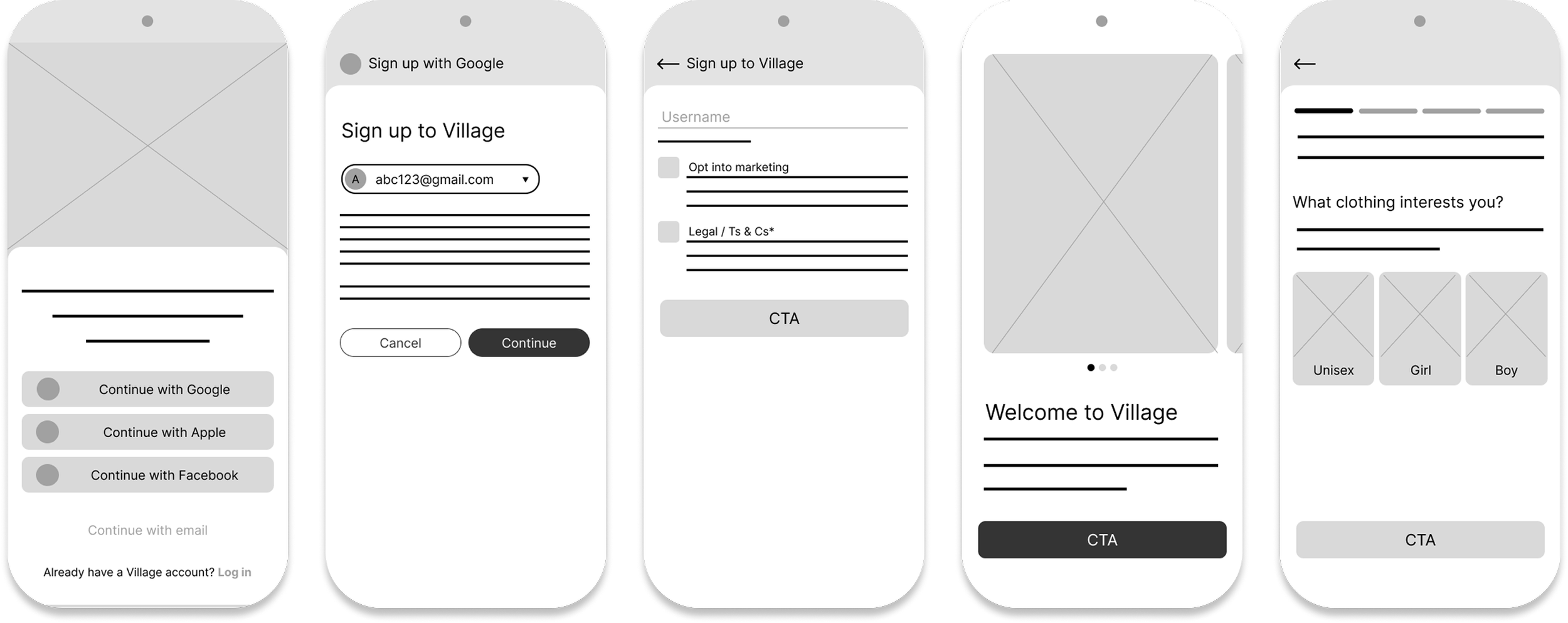
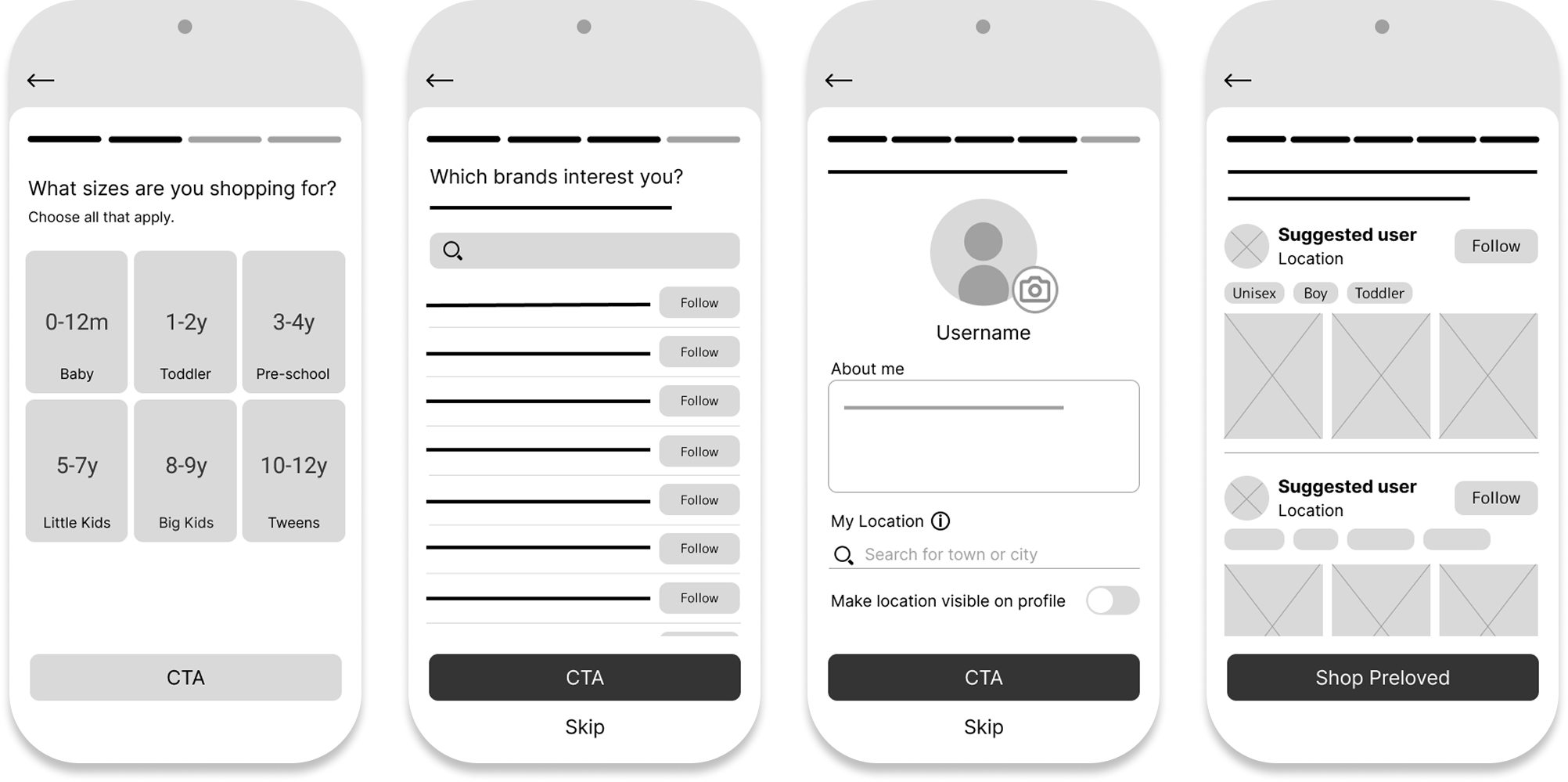
The answer was unambiguous. Participants wanted to experience value before forming social connections — being asked to follow strangers before seeing a single listing felt presumptuous. It felt like an obligation before the product had earned it. So Build Your Village moved: onboarding collects preferences only – sizes, brands, styles, a useful feed from the first session – while the social layer waits in the feed, surfaced once the product has earned the invitation.
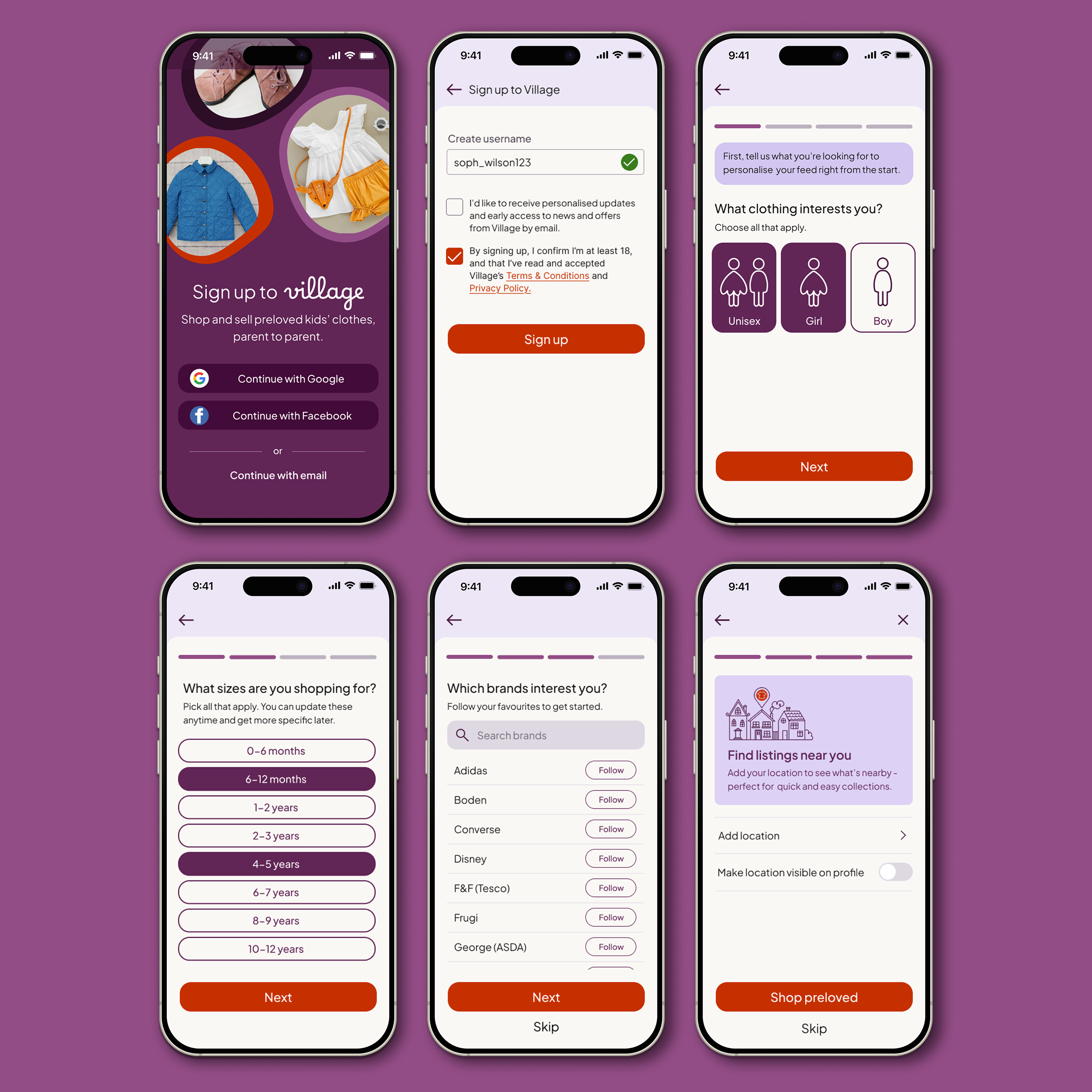
The same study produced a smaller correction. Hesitation around location sharing vanished when the benefit (local school-run pickups) was made explicit, so the generic profile step became a dedicated location step that explains the value before requesting the data.
04 · ARCHITECTURE & IDENTITY
Optional by design
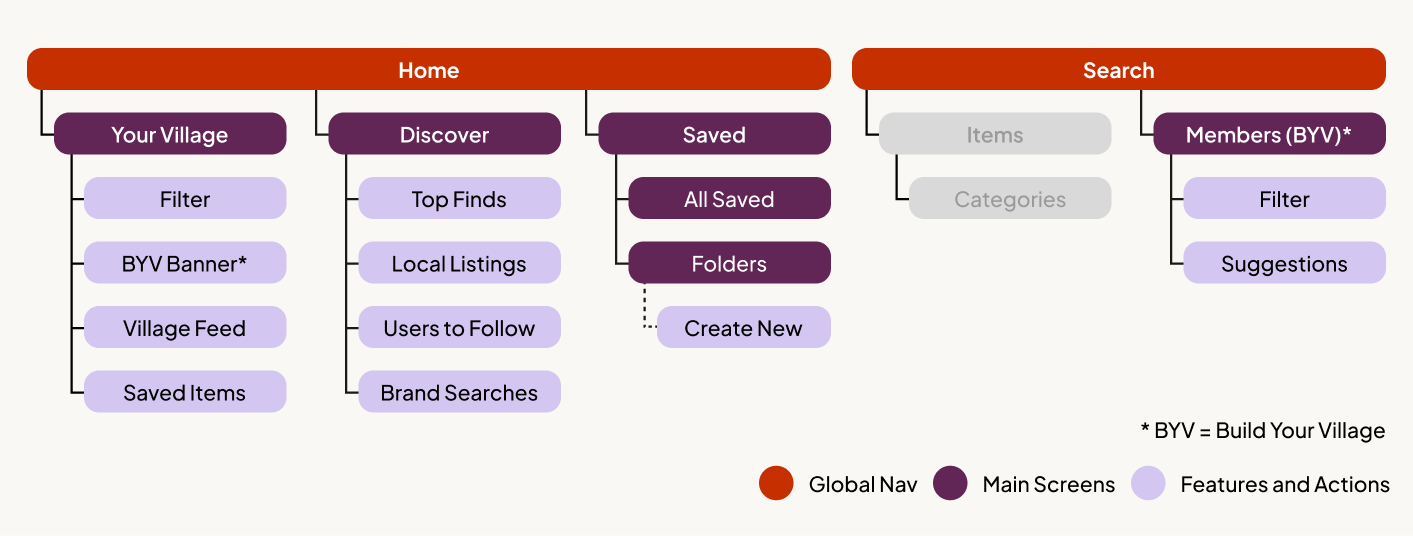
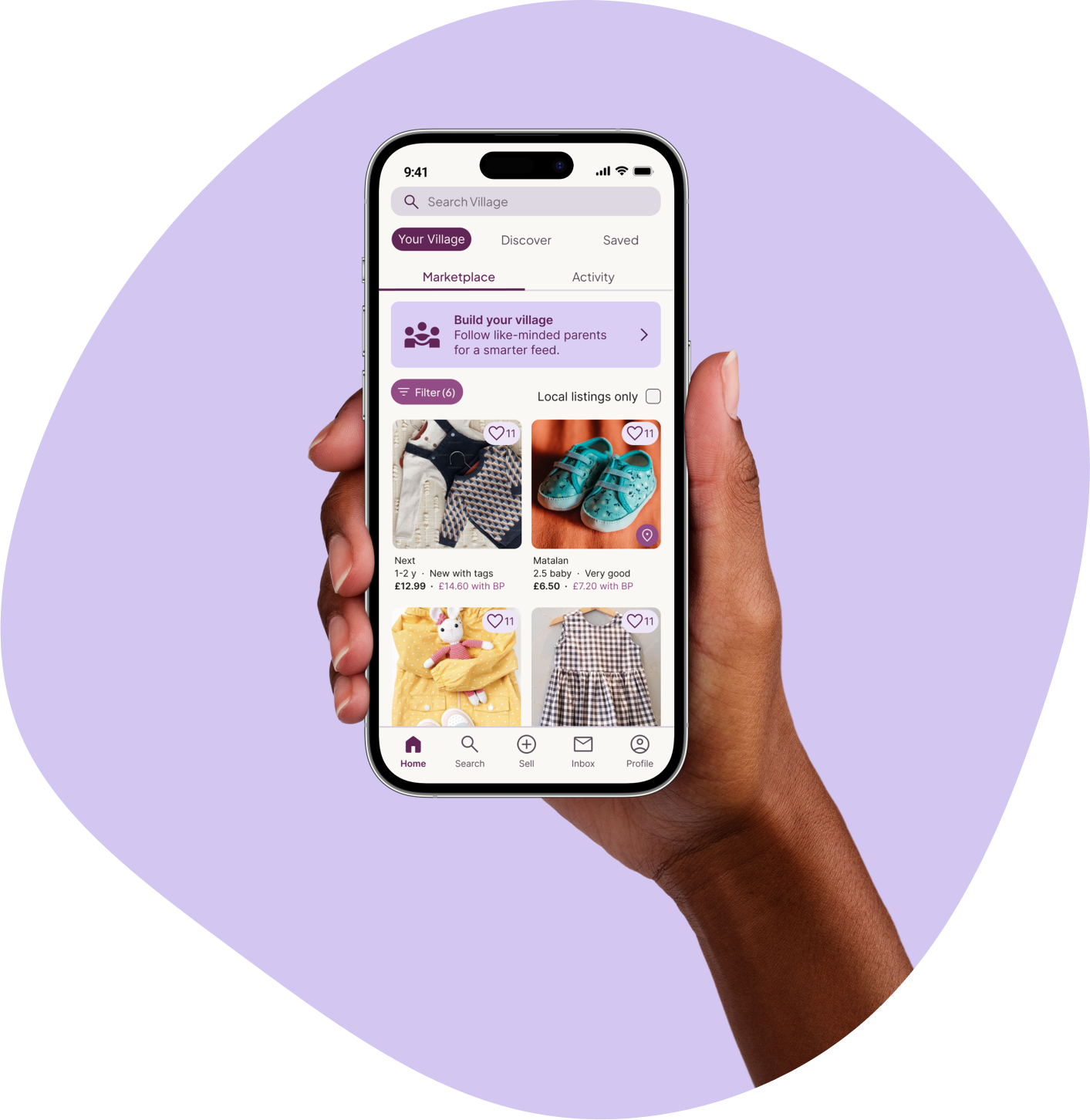
The pivot's logic — utility first, community when ready — became the information architecture. The home screen offers two browsing modes: Your Village, the curated feed shaped by who you follow, and Discovery, the full marketplace. Parents move fluidly between them; social features stay visible at the top of the feed but never block the path to listings. The IA makes the pivot permanent — community is always one tap away, and never in the way.
Design System
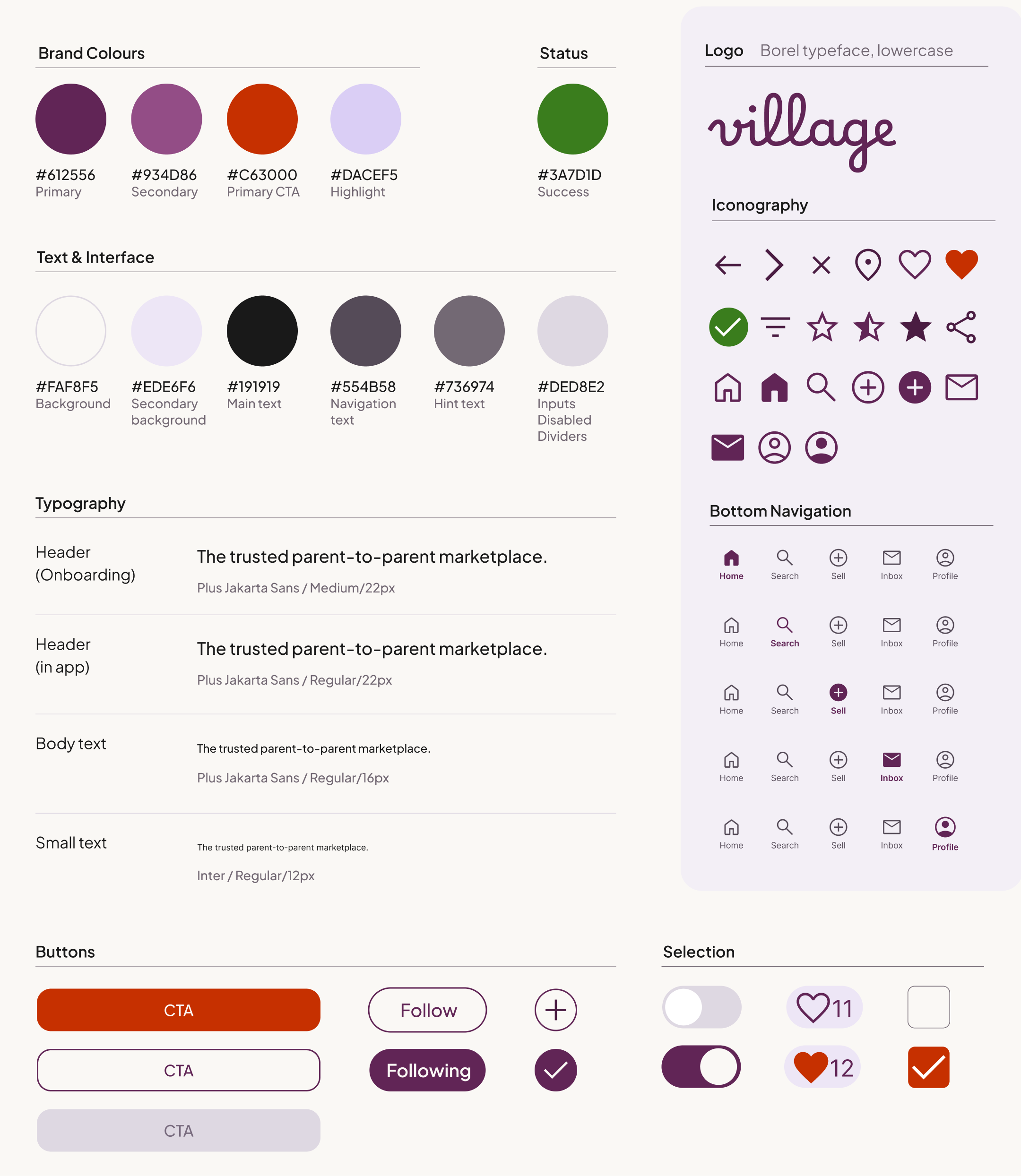
The visual identity solves the differentiation problem from the competitor scan: resale platforms converge on sustainability greens to the point of being indistinguishable. Village uses deep purples with warm accents — emotionally warmer, distinct on a home screen, and deliberately avoiding both the juvenile "baby app" look and anything so feminine it reads as mums-only. The aesthetic positions Village as a trusted, premium marketplace.
05 · HIGH FIDELITY DESIGNS
Four Screens That Carry the Concept
Onboarding
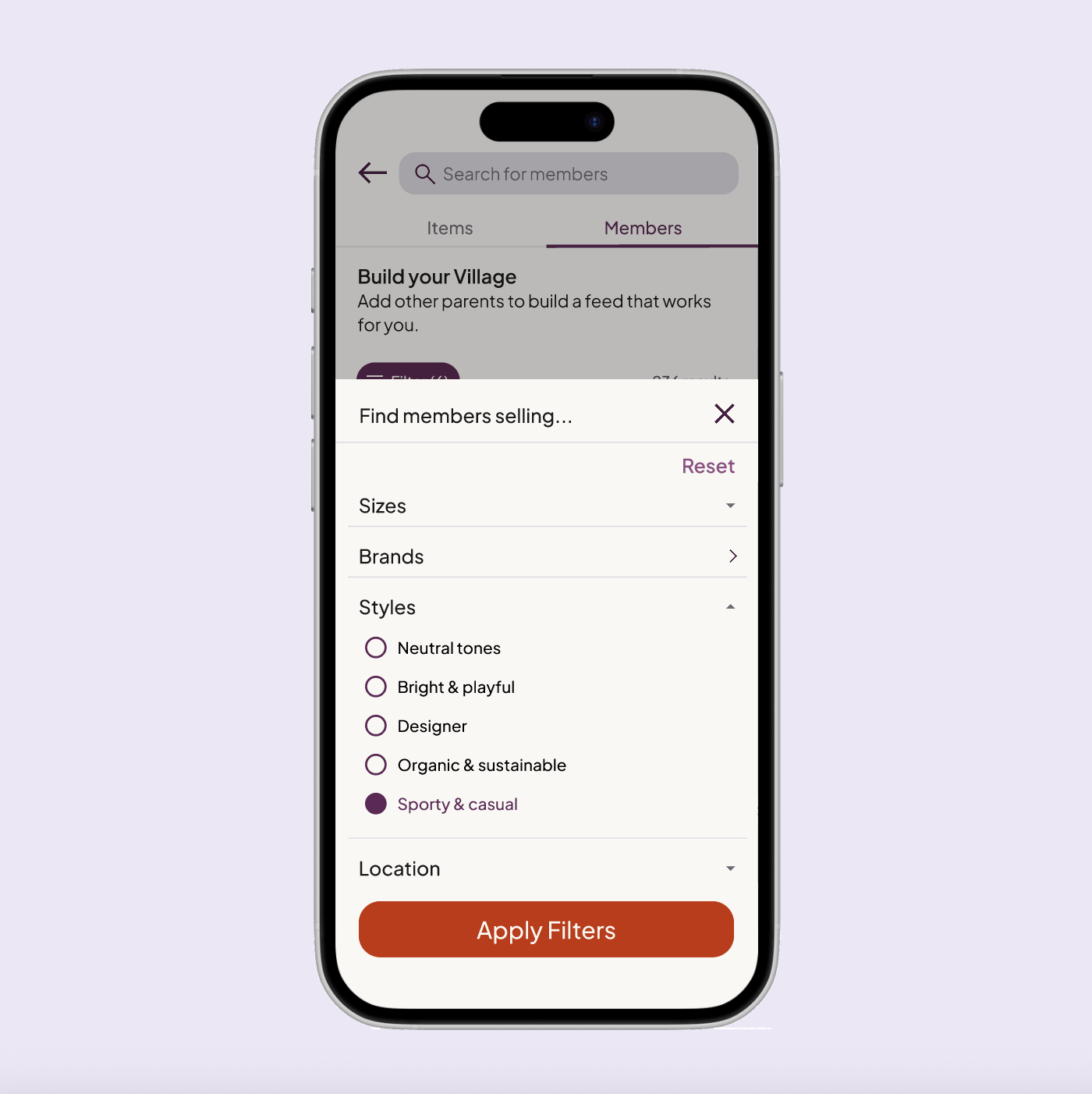
A fast, low-friction setup that collects meaningful preference data without feeling like form-filling. One-tap sign-in, flexible gender filters (including Unisex — a response to research showing many parents browse both Boys and Girls categories to find neutral items), and optional location sharing framed around a clear benefit rather than a data request. Opt-in doubled once the value came first.

The feed
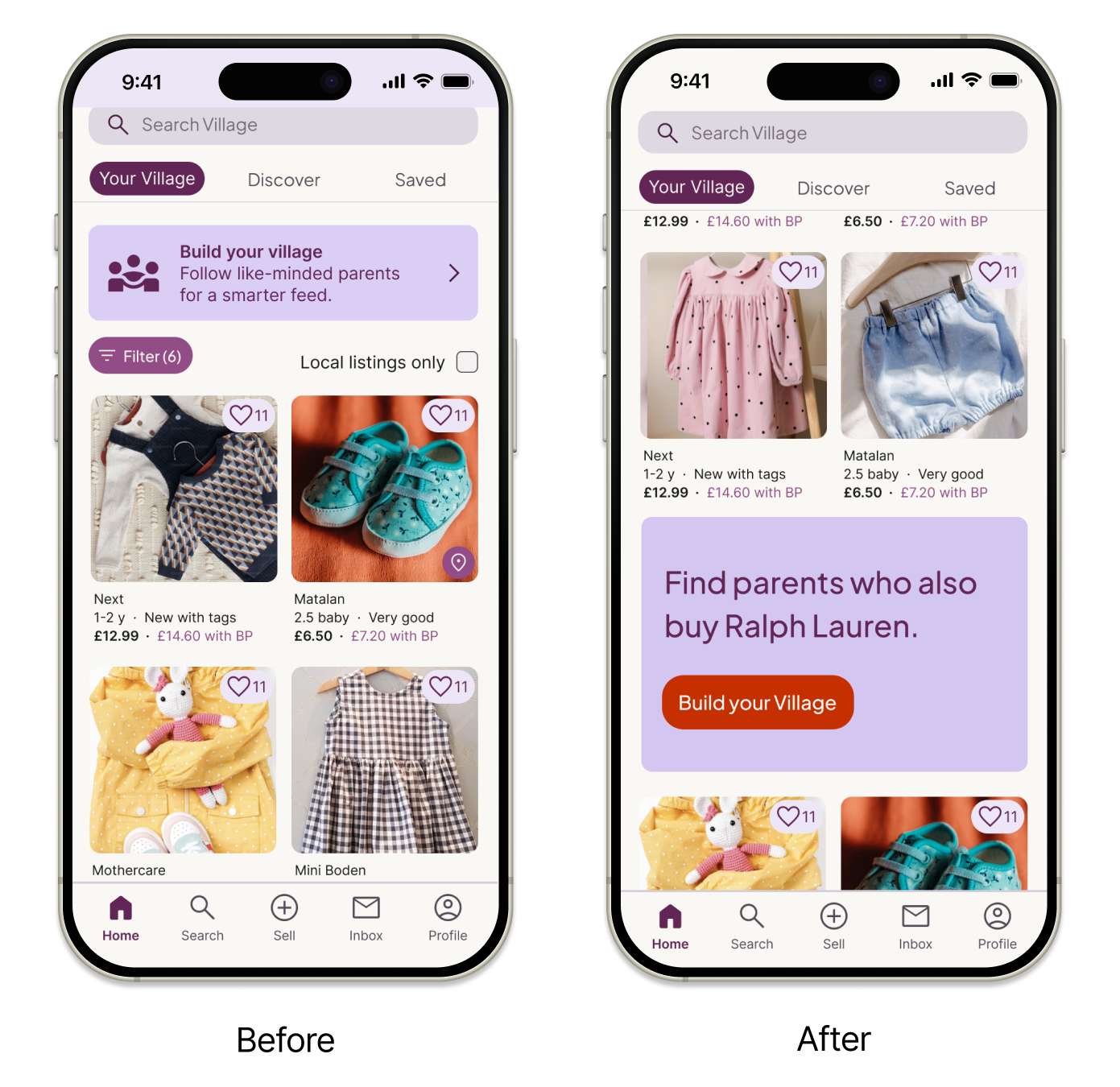
A tabbed home that keeps social curation genuinely optional: Your Village populates as you follow, Discovery is always available. Testing exposed the original "Build Your Village" banner — 3/5 participants scrolled past it — so I replaced it with a behaviour-driven hero card that surfaces contextual prompts based on browsing activity. The layout is also built for parenting's one-handed reality: primary actions in thumb reach, generous targets, structures consistent enough to navigate on autopilot.
Build Your Village
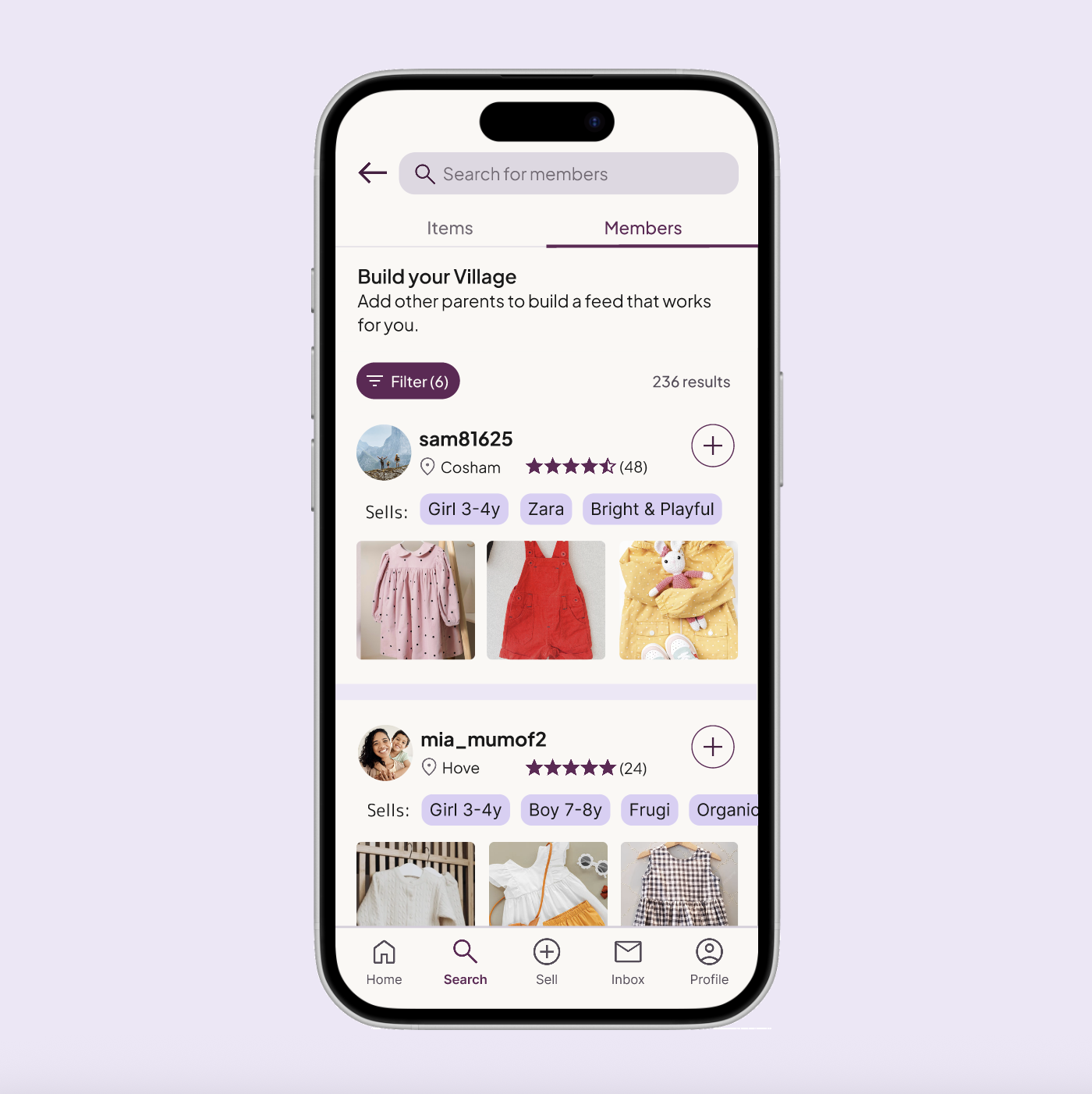
Relocated to Search → Members, making it discoverable to users in a browsing mindset, not a setup one. Member cards surface location, ratings, and "Sells" tags so parents can judge wardrobe compatibility at a glance. 3/5 participants named these tags the most useful element for deciding who to follow.
One word carried unexpected weight: "Follow" imported social-media anxiety — the weight of a visible, public, social act — so it became a neutral + icon instead. Social friction dropped to zero across participants.
User Profiles
Profiles are trust-building screens first, listing pages second. "Sells" tags in the header allow instant compatibility assessment. Verified reviews and historical sales data provide the evidence parents need before adding a stranger to their village.

06 · USABILITY TESTING
What the Numbers Said
Final round moderated testing with five participants validated the complete journey from onboarding through to discovery and social following.
Completed onboarding without assistance
Average onboarding completion time
Could imagine using Village in a real-world context
Additional findings:
Location sharing rose from 2/5 to 4/5 once the benefit led the ask.
Male participants read the UI as welcoming rather than mum-only.
What the data couldn’t tell me
This research validates usability, not the business case. The core hypothesis that effort invested in building a village translates into retention can't be answered in a testing session. It would be answered in the data:
Return-visit rate for parents who follow 3+ members vs. preference-only users
Follow-to-purchase correlation — does a bigger village drive more buying?
Feed engagement split between Your Village and Discovery over time
PROTOTYPE
Try It Yourself
The high-fidelity prototype covers the complete new-user journey: from onboarding through to the dual-mode feed, Build Your Village, and user profiles.